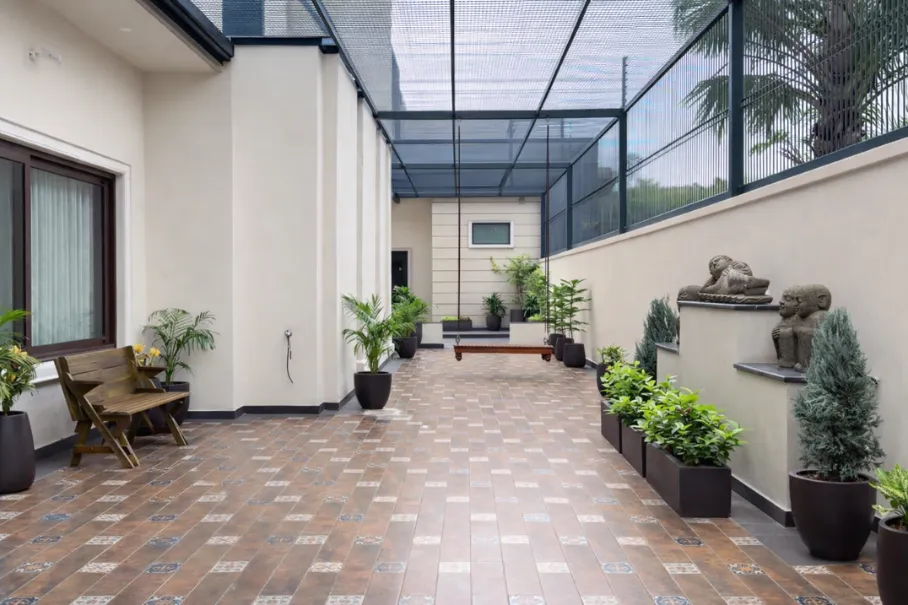
In Indian residential architecture, certain spatial ideas persist not because of nostalgia, but because they continue to serve human needs. The courtyard is one such element. While contemporary homes have evolved in form and function, the courtyard remains relevant as a space that quietly balances light, movement, and human connection. Much like Symmetry in Architecture, its value lies not in visual spectacle but in the sense of order and emotional calm it brings to everyday living.
Today, courtyards are no longer inserted as traditional motifs; they are reinterpreted as intentional pause points within modern homes.
From Climatic Response to Emotional Center
Historically, courtyards addressed climate, allowing homes to breathe through light, ventilation, and shaded interiors. In contemporary Indian homes, their role has expanded. Beyond environmental performance, courtyards now act as emotional centres, shaping how families interact, pause, and coexist.
As lifestyles become more layered and fast-paced, these open-to-sky spaces provide relief from constant enclosure. They offer moments of stillness, spaces that do not demand use but gently invite presence.
Courtyards as Spaces of Shared Living
In multi-generational or shared-family homes, the courtyard becomes neutral ground. Neither private nor public, it allows connection without intrusion. This balance is especially important in homes where individuality and togetherness must coexist.
Architecturally, such spaces echo the discipline seen in Symmetry in Architecture, a clear centre around which life unfolds. Circulation, sightlines, and everyday routines often orient themselves around this shared void, making the courtyard an anchor rather than an afterthought.
Psychological Comfort of Open-to-Sky Spaces
Light filtering through a courtyard, shadows shifting across walls, the presence of sky or greenery; these elements have a quiet psychological impact. They slow movement, reduce visual fatigue, and create a sense of openness even within dense urban settings.
In homes designed with modern luxury interior design Delhi NCR sensibilities, courtyards often soften the precision of contemporary forms, introducing warmth without excess.
Reinterpreting Courtyards in Modern Homes
Contemporary courtyards are no longer limited to central squares. They appear as linear courts, side gardens, or layered light wells integrated into living and dining spaces. Their success depends less on size and more on proportion, placement, and connection to daily functions.
Whether opening into a living area, aligning with circulation, or visually linking to spaces like a luxury modular kitchen in Delhi NCR or family lounge, the courtyard becomes part of daily life rather than a visual feature.
Balancing Togetherness and Privacy
A well-designed courtyard respects personal boundaries. Through careful orientation, thresholds, and material transitions, it allows interaction without exposure. This same design sensitivity is reflected in interiors; be it custom modular kitchens Delhi, luxury wardrobe design Delhi, or premium wardrobe and storage solutions, where balance and proportion guide usability and comfort.
Firms offering bespoke interior design solutions Delhi understand that emotional comfort stems from restraint as much as expression.
Courtyards and Contemporary Interior Thinking
In projects by luxury kitchen interior designers Delhi or custom kitchen and wardrobe designers Delhi, courtyards often influence interior layouts indirectly; guiding light, circulation, and spatial rhythm. Even associations with a high-end modular kitchen brand India benefit when architecture and interiors speak the same quiet language.
Conclusion
In contemporary Indian homes, the courtyard endures because it responds to something deeply human—the need for light, pause, and connection. Like Symmetry in Architecture, its strength lies in balance rather than display. When designed with intent, the courtyard becomes more than a space—it becomes the emotional anchor that holds the home, and its people, together.