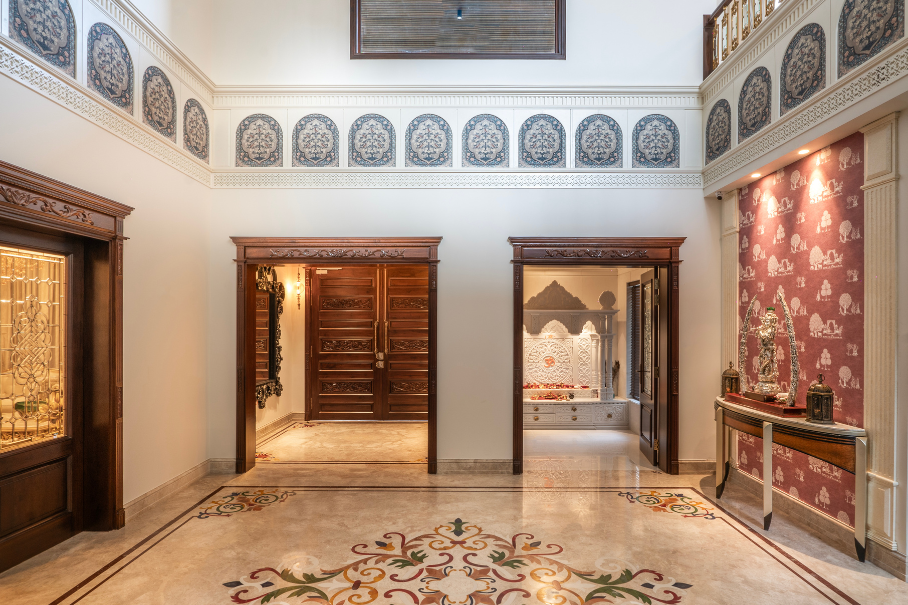
Architecture is often understood through its larger gestures, but its true character is revealed in the details. Cornices, mouldings, and architectural detailing may appear subtle, yet they play a defining role in shaping how a space is perceived. In classical design language, these elements are not decorative additions but essential components that bring coherence, depth, and refinement to both façades and interiors.
Architectural Detailing as a Design Language
Architectural detailing is a disciplined system that supports the overall composition of a building. It ensures that transitions between surfaces feel intentional and resolved. In classical architecture, detailing works alongside proportion and symmetry to create spaces that are visually balanced and complete rather than abrupt or unfinished.
Defining Transitions with Cornices and Mouldings
Cornices and mouldings serve as connectors between walls, ceilings, and architectural volumes. They soften edges and articulate junctions, allowing different elements of a space to meet with clarity. In the work of RK Malik and Associates, these transitions are handled with precision, ensuring that each intersection contributes to a seamless spatial experience.
Creating Depth, Shadow, and Hierarchy
One of the most important roles of architectural detailing is to introduce depth. Cornices and mouldings create shadow lines that change throughout the day, adding movement and richness to otherwise flat surfaces. This interplay of light and shadow also establishes visual hierarchy, helping certain elements stand out while others recede, resulting in a well-layered composition.
Historical Roots and Contemporary Relevance
Cornices and mouldings have deep historical roots in classical architecture, where they were used to define structure and proportion. Their relevance continues in contemporary classical architecture, not as replicas of the past but as evolved elements that respond to modern contexts. RK Malik and Associates reinterpret these details with restraint, maintaining their essence while adapting them to present day aesthetics.
The Importance of Restraint
Effective detailing is not about excess but about control. Overuse can overwhelm a space, while thoughtful restraint enhances elegance. By carefully selecting where and how details are introduced, architects can maintain a sense of clarity and sophistication. This approach is evident in projects by RK Malik and Associates, where detailing supports the architecture rather than competing with it.
Proportion, Material, and Craftsmanship
The success of architectural detailing depends on the relationship between proportion, material, and craftsmanship. Well proportioned mouldings feel natural within a space, while the choice of material influences how light interacts with the surface. Skilled craftsmanship ensures that these details are executed with precision, reinforcing the overall quality of the design.
Detailing and Architectural Identity
Subtle architectural details contribute significantly to the identity and character of a building. They provide a layer of refinement that distinguishes well considered architecture from the ordinary. In the work of RK Malik and Associates, detailing becomes a quiet yet powerful tool that enhances both visual appeal and spatial experience.
Conclusion
Thoughtful architectural detailing remains essential to timeless design because it brings depth, clarity, and refinement to a space. Cornices and mouldings may be subtle, but their impact is lasting, shaping how architecture is seen, experienced, and remembered.