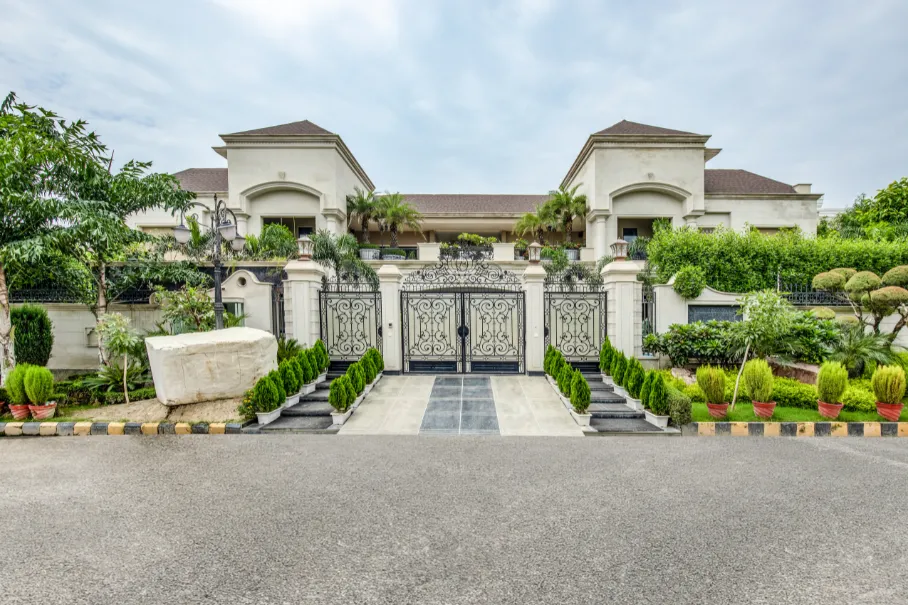
In residential design, some principles quietly endure while others fade with time. Symmetry in Architecture is one such principle, often misunderstood as rigid or old-fashioned, yet consistently present in homes that feel composed, calm, and timeless. When applied with intent, symmetry is less about mirroring forms and more about establishing balance, clarity, and visual order in everyday living environments.
For architects and designers, symmetry is not a stylistic choice; it is a design discipline that helps spaces age gracefully.
Symmetry as Visual Calm, Not Decoration
At its core, symmetry creates a sense of equilibrium. Human perception is naturally drawn to balance, and symmetrical compositions offer an immediate feeling of stability and comfort. In residential architecture, this translates into homes that feel grounded rather than overwhelming.
Unlike decorative trends that rely on surface-level impact, symmetry works quietly. It organises spaces, aligns circulation, and gives structure to form. This is why homes designed with strong proportional logic often feel reassuring, even decades later.
Classical Roots, Contemporary Relevance
Historically, symmetry formed the backbone of classical architecture, expressed through axial planning, proportional relationships, and rhythmic facades. While contemporary homes no longer replicate classical ornamentation, the underlying logic remains relevant.
Modern residential design often adapts these principles subtly. A balanced elevation, a central axis anchoring the plan, or evenly distributed openings can bring order to contemporary forms without appearing formal. This balance becomes especially valuable in large residences or multi-family homes, where visual clarity prevents architectural chaos.
Balancing Symmetry with Modern Living
One common misconception is that symmetry restricts flexibility. In practice, the opposite is true. While the overall structure may follow a symmetrical framework, internal planning can remain fluid and responsive.
Open layouts, adaptable living spaces, and personalised interiors coexist comfortably within symmetrical shells. This balance is particularly evident in modern luxury interior design Delhi NCR, where architectural restraint allows interiors to evolve with lifestyle needs rather than compete with them.
Symmetry Beyond the Facade
While symmetry is most visible on elevations, its real impact lies inside the home. Balanced layouts improve wayfinding, enhance spatial flow, and create intuitive transitions between private and shared spaces.
This logic extends seamlessly into interiors; whether in a luxury modular kitchen in Delhi NCR, where aligned cabinetry and centred islands enhance usability, or in premium wardrobe and storage solutions that rely on proportional planning for long-term efficiency. Symmetry supports function without announcing itself.
Interiors that Respect Architectural Balance
In high-quality interior projects, be it custom modular kitchens Delhi or luxury wardrobe design Delhi, symmetry often forms the invisible framework. Even bespoke solutions benefit from balanced compositions, especially when designing for longevity.
Many luxury kitchen interior designers Delhi and custom kitchen and wardrobe designers Delhi rely on symmetrical planning to bring cohesion to personalised spaces. It allows materials, textures, and detailing to stand out without visual clutter, reinforcing the idea that refinement comes from restraint.
Why Symmetry Endures
Trends respond to the present moment. Symmetry responds to human perception and lived experience. It offers a visual anchor in a rapidly changing world, making homes feel composed rather than performative.
For those seeking bespoke interior design solutions Delhi or aligning with a high-end modular kitchen brand India, the most enduring designs are rarely the loudest. They are the ones that feel intuitively right; balanced, thoughtful, and quietly confident.
Conclusion
Ultimately, Symmetry in Architecture is not about rigid repetition but about creating harmony that supports everyday life. When used thoughtfully, it provides structure without stiffness and elegance without excess. In residential design, this visual balance becomes the foundation for homes that remain relevant, comfortable, and timeless, long after trends have passed.